My CCDE Journey
Earning my CCDE certification (CCDE 2026::37) was one of the hardest things I have done in my professional life. Not because the topics are impossibly complex, but because the exam requires a depth and breadth of design knowledge that takes real time and effort to build. And also because, at 52, learning takes longer than it did at 30.
This article is a candid description of my journey to get there: two attempts at the written exam, three attempts at the practical exam, two bootcamps, a LOT of reading and perseverance.
This post is the third in a series about the CCDE certification journey. The first post covers exam-day tips and tricks for the practical. The second post covers the reading list: the books and video courses I used for both the written and the practical. And this post covers my full study journey: my background, the courses I attended, the study material and practice exams I used, what I would do differently, and more…
My Background Before Starting
Experience
I came into the CCDE with a solid foundation of experience behind me. I have been working in network engineering since 1996; Thirty years across service providers, enterprises & campus networks, and data centers. As an engineer, peering manager, engineering and operations manager, senior network solutions consultant, and now as lead of a network and cloud team. I also have extensive experience working directly with customers to discuss business needs, requirements, and constraints. That breadth of exposure is genuinely valuable for the CCDE, which tests design thinking across all these domains. If you have spent your career in a single vertical, you may need to invest extra time broadening your exposure before the exam.
Certifications
I also hold multiple CCNP certifications: Automation, Service Provider, Enterprise (R&S), and Data Center, which meant many of the technology domains on the CCDE blueprint were already familiar territory. And, by the way, I also have the retired CCDA and CCDP certifications.
In addition, one of the preparations that mattered most was something I did not originally intend as CCDE preparation. Between 2015 and 2017, I worked intensively toward the CCIE Enterprise Infrastructure certification. During that time, I passed the CCIE written exam twice and attended two Narbik Kocharians bootcamps. Narbik’s Micronics Training bootcamp is well known for being one of the most in-depth in the industry. I sat the CCIE lab exam three times between June 2016 and March 2017, but did not pass.
At the time, it felt like a failure. But looking back, this experience gave me something that no amount of reading can replace: a rock-solid foundation built through intensive hands-on practice on Layer 2, Layer 3, routing protocols, MPLS, Quality of Service (QoS), and all the other topics covered in the CCIE Enterprise curriculum. This foundation made it much easier for me to master the technical aspects of the CCDE exam. The CCDE is not a configuration exam, but you cannot design what you do not deeply understand.
A Note on Learning After 50
I am 52 years old (born in 1973), and I would like to share what that means for exam preparation. It takes me longer to absorb and retain new material than it did twenty years ago. This is not pessimism; it is biology! Research consistently shows that while accumulated knowledge and professional experience continue to grow with age, the speed of new learning and working memory capacity gradually decline from around the mid-30s onward.
This does not mean it is impossible; clearly it is not. But it does mean you need to be realistic about your study timeline, more deliberate with spaced repetition, and more disciplined about rest and recovery. Cramming the week before the exam is less effective at 50 than at 25. Consistent, sustained preparation over a longer period works better.
I think it is important for candidates in the same situation to know: it is normal if it takes you longer. Plan accordingly, and do not be discouraged.
The Written Exam (400-007) & AI area of expertise
I started my CCDE journey in early 2024 by focusing on the written exam. My preparation was straightforward: I read the Cisco Certified Design Expert (CCDE 400-007) Official Cert Guide by Zig Zsiga, cover to cover. That book is the most structured and complete resource for the written exam blueprint, and I would recommend it as the first thing any candidate reads.
I sat the written exam at Cisco Live US in June 2024… and failed. But that conference turned out to be a pivotal moment for another reason: Cisco announced a new CCDE area of expertise at Cisco Live 2024: CCDE – AI Infrastructure, covering the design of AI/ML network infrastructure. Given that my work at CSCS involves leading the network and cloud team supporting HPC and AI infrastructure, the choice was obvious. That decision shaped a significant part of my practical preparation, particularly around AI networking topics.
I used the time between the two written attempts to go deeper on the topics where I felt weakest, and to start building the broader reading list that would carry me through the practical preparation.
Then, I took the written exam again in November 2024 and passed.
Preparing for the Practical — The Full Journey
Deep Learning Phase (December 2024 – June 2025)
With the written exam behind me, I shifted focus entirely to the practical. The first major investment was a 24-month “all-access + bootcamp” subscription to orhanergun.net, which includes all video courses, books, and access to the CCDE bootcamps. This is a very good investment: the CCDE video course, the book, and bootcamp already justify the cost, but the platform also includes a large library of other high-quality courses covering topics well beyond the CCDE blueprint. I would recommend this subscription to any CCDE candidate.
The centrepiece of this phase was the Orhan Ergun CCDE online course: 80 hours of video content covering the full CCDE blueprint in depth. This is not a passive watch; it requires active engagement, note-taking and reviewing to maximise its benefits.
Alongside the course, I worked through my O’Reilly reading list, covered in detail in this post, and also studied different resources and white papers I had accumulated over a long time.
And as AI infrastructure is my area of expertise, I also completed the Cisco U “AI Solutions on Cisco Infrastructure Essentials” (DCAIE) course. It was a free Cisco U “re-cert” course at this time.
In total, during that period, I spent between 6 and 7 months reading books and watching videos on the subject. Not a single lab, not a single line of configuration… but it was really exciting. Those are the moments when the more you learn, the more you realize there’s even more to learn beyond that.
Cisco Live US — June 2025
Cisco Live was, again, a significant milestone. Between many other sessions, I attended two CCDE-focused sessions, both led by the same three exceptional speakers: Zig Zsiga (Principal Architect, CCIE #44883, CCDE #20160032), Mark Holm (CCDE Exam Program Manager, CCIE #34763, CCDE #20160020), and Rick Bauer (Technical Solutions Architect, CCIE #9482, CCDE #20140008) — all three Cisco Live Distinguished Speakers and Hall of Fame Speakers.
- LTRCRT-3000 — CCDE Tectorial: a 4-hour session that included a graded practice scenario. A two-hour exercise, which was my first genuine practice lab under realistic exam conditions.
- BRKCRT-3999 — “Don’t AI networks design themselves?”: a breakout session covering AI infrastructure and network design for CCDE candidates.
If you have the opportunity to attend Cisco Live and participate in a CCDE Tectorial, do it! There is no substitute for working through a real scenario with grading and feedback. And if any of these three speakers are presenting a session, go for it.
Closing the Gaps (June – August 2025)
After Cisco Live, I had a clearer picture of where my knowledge was to improve. I used mid June, July, and August to close those gaps systematically by studying:
Orhan Ergun CCDE Technology Course by Mohamed Radwan
I worked through specific chapters on the CCDE Course by Mohamed Radwan, available on the orhanergun.net portal. Focusing on topics I wanted to review:
- Routing and routing protocols: IS-IS, OSPF, EIGRP, even a bit of RIP, then IGP Comparison & a bit of FHRP.
- MPLS Applications, Inter-AS & Use Cases
- MPLS TE & CSPF
- Multicast Routing and Use Cases
- Security & Tunneling
- Network Management
- Designer Skills (particularly the requirements section)
- SR, SRv6, and EVPN
Zig Zsiga’s free resources
At: zigbits.tech/resources — specifically:
- Guide to the Benefits of SD-WAN
- Non-technical Guide to the CCDE Practical
- DC Interconnect Options
Cisco Live sessions
I watched the following recordings, which I found particularly useful.
Cisco Live sessions are available on the Cisco Live on-demand portal.
- DGTL-BRKRST-2337 (Virtual 2020) — OSPF Deployment in Modern Networks, by Nick Russo (R.I.P.)
- BRKENT-2007 (CLUS 2023) — IS-IS Deployment in Modern Networks
- BRKENS-2500 (CLUS 2025) — Advanced Campus Network Design: Multilayer Architectures and Next-Gen Protocols
- BRKMPL-2103 (CLUS 2025) — Mastering BGP: A Deep Dive into Basics and Design Best Practices for BGP and L3VPN
- BRKRST-3321 (CLEUR 2016) — Scaling BGP
- BRKIPM-3017 (CLUS 2017) — mVPN Deployment Models
- BRKENT-2004 (CLUS 2022) — mVPN Profile 14: This is the Way
- BRKSP-2551 (CLEUR 2025) — Introduction to Segment Routing
- BRKDCN-2941 (CLEUR 2025) — Advanced Storage Area Network Design
- DGTL-BRKSEC-3052 (Virtual 2020) — Demystifying DMVPN
- BRKENT-2076 (AUS 2022) — SD-Access Design
I also refreshed my OSPF area types knowledge with this video by Narbik Kocharians: OSPF Area Types.
(I remember Narbik did the same presentation during my CCIE bootcamp, fantastic!)
Cisco Validated Designs (CVDs) and white papers
The Cisco Design Zone is a great resource. I worked through the following:
- Campus LAN and WLAN Design Guide
- SD-Access Solution Design Guide
- Cisco Catalyst SD-WAN Design Guide
- Cisco Catalyst SD-WAN Case Studies (6 case studies)
- IWAN to SD-WAN Migration Guide (PDF)
- VXLAN with MP-BGP EVPN Control Plane Design Guide
- Cisco Nexus 9k VXLAN BGP EVPN Design and Implementation Guide
- GETVPN Design and Implementation Guide (PDF)
- DMVPN Concepts & Configuration
AI-related documentation
I studied the following resources for the AI elective:
- Design guides for AI-ready infrastructure (huge list!)
- Cisco Data Center Networking Blueprint for AI/ML Applications (Very important for the AI elective!)
- Cisco Validated Design for Data Center Networking Blueprint for AI/ML Applications
- Toni Pasanen’s book: Deep Learning for Network Engineers. A great book! And also many articles from his blog: nwktimes.blogspot.com
- RoCE Networks for Distributed AI Training at Scale — Meta Engineering
- Benefits of RDMA over Routed Fabrics (PDF) — NVIDIA
- Introduction to RoCEv2
- NVIDIA Reference Architecture Documents for AI Enterprise (ERA and NCP)
For candidates who have chosen AI infrastructure as their area of expertise, I would like to add three articles I have written:
- NVMe, NVMe over Fabrics and RDMA for network engineers
- RDMA over Converged Ethernet – RoCEv2 on Cisco Nexus 9300
- Understanding Scale-Out, Scale-Up, and Scale-Across Networking
Orhan Ergun YouTube videos
I found particularly useful:
- Google Datacenter Network Design
- BGP Design and Deployment in the Datacenter
- OSPF Routing Protocol Questions and Answers
- DMVPN vs GETVPN Comparison
- EVPN Deep Dive — All EVPN Route Types
Practice Exams and Final Preparation (September – October 2025)
This is the phase where everything comes together…
Practice scenarios are essential. Reading and watching courses builds your knowledge, and then practice scenarios build your exam technique.
I worked through the following:
- 4 CCDE Practical Scenarios by Mohamed Radwan (available on orhanergun.net). My approach for each was: read the scenario first and attempt the questions independently, then watch the video walkthrough to compare and understand where my reasoning diverged. Important note: the questions in the PDFs are sometimes different from the questions in the video. But it’s a great resource anyway.
- 3 Scenarios from the CCDE v3 Practice Labs book by Martin J. Duggan (Cisco Press, available on O’Reilly) — these are the closest thing to the actual exam format I found. Work through them without looking at the answers first.
- Zig Zsiga’s Scenario #1 — available free at zigbits.tech/resources. A good additional scenario, and free.
The CCDE Learning Matrix — available on the Cisco Learning Network. This is for the blueprint v.3, but still valid and contains a good list of resources.
My personal “To Review” list — throughout my preparation, I maintained a running list of topics I needed to revisit, concepts I was unsure about, and questions I had gotten wrong in practice. As this list is specific to my gaps, I think it’s useless to share it here, but building and maintaining your own list of topics is something I strongly recommend.
Orhan Ergun CCDE bootcamp (Oct. 13-24, 2025, ~ 80 hours). Due to a scheduling conflict, I was only able to participate in the first week of the bootcamp, before my first practical exam.
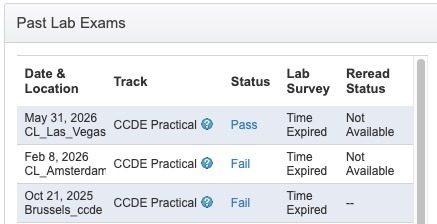
First Lab Attempt — October 21, 2025: Failed
I sat the practical exam for the first time on October 21, 2025, immediately following the first week of the Orhan Ergun bootcamp. And I failed.
Looking back, taking the exam at the midpoint of the bootcamp was not ideal. The bootcamp itself is excellent, but I did not have enough time to consolidate my learning before the exam.
In addition, the last preparation phase (practice) was too brief for me. But it is also necessary to take the practical exam at some point to fully understand what the exam looks like and where you stand in your preparation.
Between Lab Attempts 1 and 2 (November 2025 – February 2026)
Additional study during this period:
- Orhan Ergun chapter on CAPEX/OPEX, ROI, reliability, redundancy, and business-related design considerations.
- Russ White’s “Understanding Overlays and Tunnels” on the Orhan Ergun portal.
AI resources reviewed — I revisited the AI-related resources from the previous phase, this time with a sharper focus on data sovereignty, regulations, cloud, and the different AI workloads (pre-training, training, inference).
Second Orhan Ergun bootcamp (January 26 – February 6, 2026, 80 hours) — I attended the full bootcamp this time, with the exam immediately after. I took detailed notes and used the sessions to address the specific gaps I had identified in my first attempt.
Second Lab Attempt — February 8, 2026: Failed
I sat the practical on February 8, 2026, the day before Cisco Live Amsterdam. Failed again but with a better score.
Two failures are hard. There is no point pretending otherwise. But each attempt gave me information about where my understanding or knowledge was still insufficient, and I used that information methodically.
Between Lab Attempts 2 and 3 (February – June 2026)
This was the longest inter-attempt period, and the most focused: I reviewed many, many, many topics from the above lists.
Additional topics studied:
- 802.1x components — a detailed review of all components, roles, and design considerations.
- AI topics continued, with a focus on congestion control for RoCE networks:
Third Lab Attempt — May 31, 2026: PASS! CCDE 2026::37
I took this exam at Cisco Live US 2026 in Las Vegas. On the Sunday before the conference opens, it is possible to sit for an expert-level lab exam. It’s already something to sit for an expert exam at Cisco Live, but passing it in Vegas is totally amazing!
Palmer Sample is a good friend, an outstanding engineer, a dual CCIE, and a Cisco Live Hall of Fame Speaker. He knew I was going to take the exam, and had apparently mentioned me to the proctor. Just before starting the exam, when the proctor came to collect the candidates and check IDs, he looked at mine and said, straight-faced: “Someone told me to give you special treatment, so I’m going to seat you at the table that’s in full sunlight and closest to the music coming from outside.“ I immediately thought of Palmer, and had a good laugh. That helped me to relax as I walked into the exam room.
I received my result in the evening, sitting at a bar with Palmer. He knew I had passed a few seconds before I did, as he had been chatting with Mark Holm, the CCDE Exam Program Manager. He suggested, in a very Palmer way, that it was a very difficult exam and I shouldn’t get discouraged… but that I should probably check the CCIE portal anyway to see my result. In about 20 seconds, I went from completely depressed to seeing “PASS” on the screen. And of course, he filmed the whole thing. Thanks, Palmer; I’ll remember this moment for the rest of my life!
The rest of the conference week was equally amazing. Congratulations came from so many people and friends, including some of the true rock stars of the networking community, which I found deeply humbling. I was even able to get my badge updated to include my CCDE number and attend the CCIE/CCDE party. A perfect end to a very long and intense journey.
A few more details, but the devil is in the details.
Looking back across the full journey, a few things stand out:
Do one practice scenario early. You do not need to be fully prepared to benefit from an early practice scenario. In fact, doing one at an early stage gives you a concrete sense of how the practical exam is structured and what is expected. You do not need to score well; you need to understand the format. If possible, attend a Cisco Live CCDE Tectorial early in your preparation; this is exactly what it is designed for. And keep the remaining practice scenarios to assess yourself closer to the exam, when you are ready to get feedback on your performance. This is actually close to what I did, and I would do it the same way again.
Do not sit the exam mid-bootcamp. Any bootcamp is intense. Give yourself at least a few weeks after it finishes to consolidate, review your notes, and do additional practice scenarios before the exam. It’s not always possible, but my first exam in the middle of the bootcamp wasn’t the best experience.
Build your “To Review” list from day one. Every time you encounter something you are not sure about, add it. Then review it regularly. This list becomes one of your most valuable resources in the final weeks.
Give yourself enough time for the practice phase. For my first attempt, I had only two months between starting practice scenarios and sitting the exam (September–October 2025). Looking back, that was clearly not enough. The challenge is that the available practice material is limited. Beyond the resources I listed in this post, there is not much else out there. And redoing the same scenarios probably gives low returns: once you know the scenario and the answers, you are no longer truly testing yourself. My advice would be to spread the practice phase over more time, work through each scenario carefully, and use the time between scenarios to go back and close the knowledge gaps that each scenario reveals. In short: quality over quantity.
Summary
The CCDE is a long journey. Mine took from early 2024 to the end of May 2026; around 29 months, two written attempts, three practical attempts, two bootcamps, and more hours of study than I care to count. But it is worth it!
If you are on this path, stay with it. The exam is hard, the journey is long, and the failures along the way are part of it. But what you build in this process is the way you think about network design; constraints, trade-offs, and business requirements will stay with you during your entire career.
Good luck!
There are three articles in this series about the CCDE:
- Post 1: Exam-Day Tips and Tricks.
- Post 2: Reading List.
- Post 3: My CCDE Study Journey.
Congratulations! Thank you for taking the time to compile your resources and journey experiences. Extremely helpful to those of us pursuing the DE!
Thank you very much, Jim.
WOW, what a great article and what a challenging journey! I am currently working toward my CCIE SP, and honestly, the more I study, the more I feel I know very little.
I am also thinking about taking the CCDE written exam in November this year. Seeing how demanding this exam is, despite having design experience, and looking at the links you shared which I truly appreciate I realize how much I still have to learn.
Congratulations on your achievement, and hopefully, one day I will become a CCDE too!
Thank you Daniel. And good luck with the exam.